Greenhouse Gas Emissions
Methane is a crucial greenhouse gas whose emission reduction can effectively mitigate climate change on a decadal time scale. Our study explores methane emission characteristics from point sources to global scale. We further combine isotopic measurements with satellite data to improve emission quantification.
Point Sources: Methane emission estimates from major livestock and waste operations in the agricultural US Midwest are biased by 40%–80%, revealing large inherent uncertainties in extrapolating limited in-situ data to larger scales. Example findings are here.
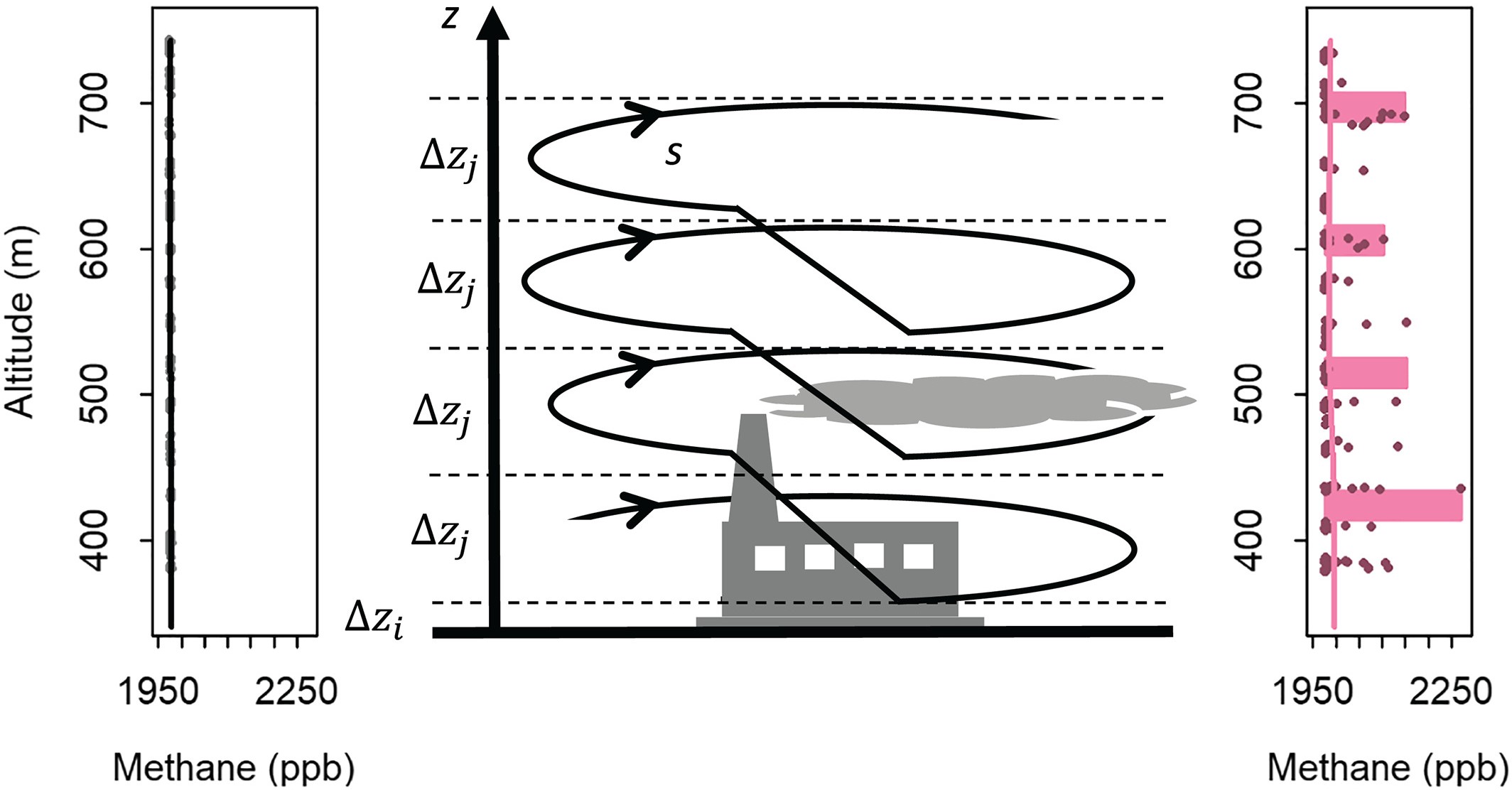
Point source quantification for a facility (Yu et al., 2020).
Regional: We quantified the importance of the US Upper Midwest for the national methane budget. The region includes extensive wetlands and is a world center for livestock operations. Our research reveals substantial carbon mitigation opportunities for the area, that up to 4.5 Tg/y emission reductions could be achieved through widespread deployment of anaerobic digestion. Example findings are here.
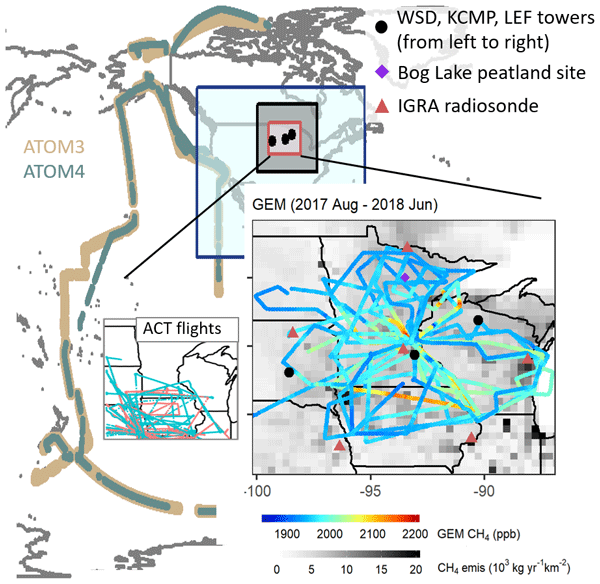
Regional emission quantification in the Upper Midwest (Yu et al., 2021).
Global: Interpreting two years of space-based methane measurements from TROPOMI, we showed that two key regions contributing to the accelerating methane growth are the Middle East (with rapid emission increases from fossil fuel explorations) and South Asia (with strong seasonal emissions linked to Monsoon rainfall). Example findings are here.
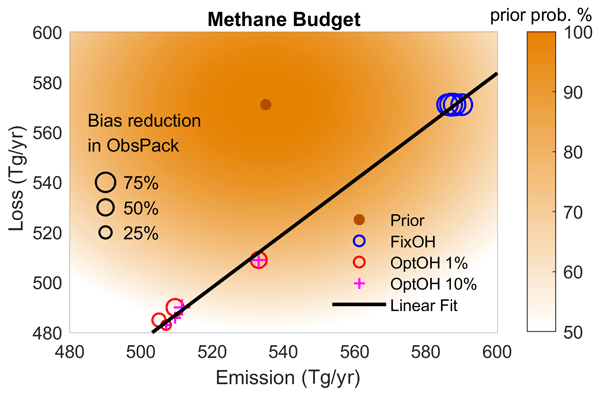
Global methane budget in year 2019. Simultaneous source + sink optimization using methane observations alone remains an ill-posed problem – even with the dense TROPOMI sampling coverage. (Yu et al., 2023).
Isotopes: Incorporating methane isotopologues alters tropical and subtropical methane emission estimates. Example findings are here.
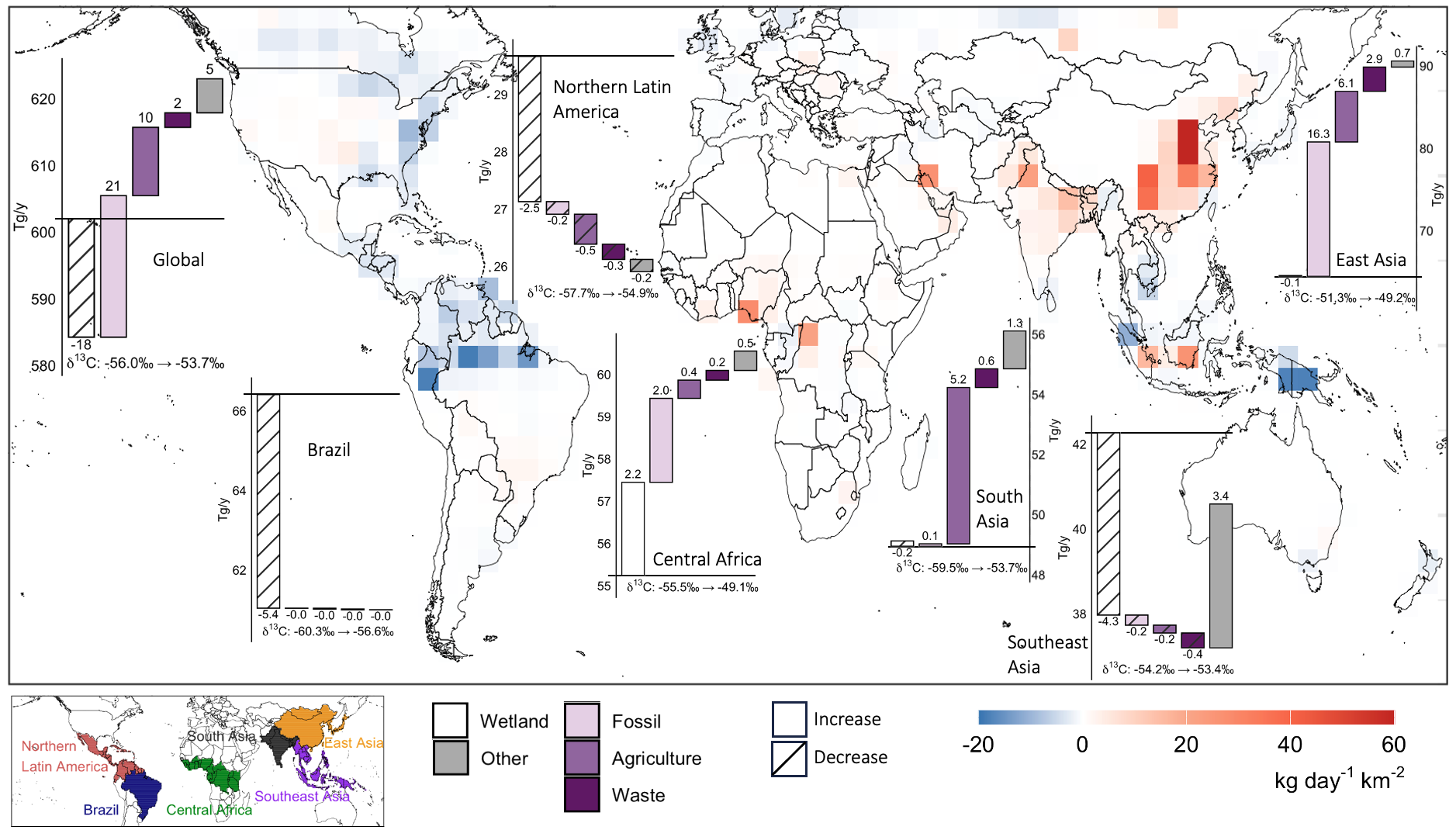
Isotopic measurements revise tropical/subtropical methane emission estimates (Yu et al., 2026).